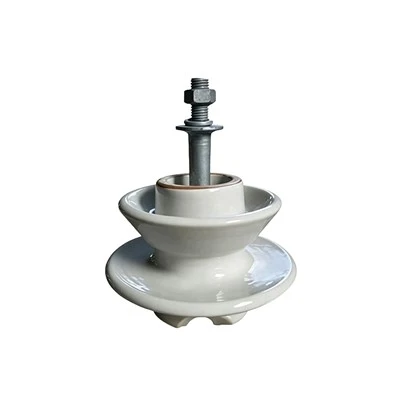
Hey everyone, if you’ve ever worked with overhead power lines or electrical distribution systems, you’ve probably run into steel post insulators—even if you didn’t realize it. As a supplier of these critical parts, I get tons of questions about them, and one of the most common is: “What’s the insulation resistance of a steel post insulator?” It’s not a random number we pull out of thin air; it’s a spec that matters a ton for keeping power flowing safely and avoiding costly issues. Let me break this down like I would for a new electrician or someone just getting into the industry, no stuffy jargon overload (promise).
First, let’s quick recap what a steel post insulator actually does, because that’s key to understanding its insulation resistance. Unlike pin insulators that sit on crossarms, or suspension insulators that hang from transmission lines, steel post insulators are mounted directly on a steel pole or structure. Their whole job is to hold live electrical conductors in place and keep those conductors from touching the steel pole (which would cause a short circuit, outages, or even fires). So the “insulation resistance” here is basically a measure of how well the insulator resists electrical current leaking through it—like a filter for bad current, keeping it where it’s supposed to be.
Now, let’s get to the numbers, but before I dive in, a quick heads up: insulation resistance isn’t a one-size-fits-all value. It depends on a bunch of factors, which I’ll cover, but there’s a baseline that’s been tested and agreed on for standard applications. From the thousands of insulators we’ve supplied over the years, and the industry standards we follow, typical insulation resistance for a new, clean steel post insulator is between 100 megaohms (MΩ) and 10,000 MΩ. Wait, let’s put that in perspective: 1 MΩ is 1 million ohms, so 100 MΩ is a million times more resistant than a standard household light bulb filament. That’s how tough these are at blocking leak current.
But why such a big range? Let’s talk variables. First, the material of the insulator’s outer layer (the part that actually does the insulating). Most steel post insulators use either composite polymer, glass, or even porcelain—though porcelain is less common these days for post-style. For example, our composite line post insulators are built with a silicone rubber housing, which has insulation resistance right around the 1,000 to 10,000 MΩ mark when new. Glass line post insulators tend to be a little lower, around 500 to 5,000 MΩ, because glass is slightly more porous than polymer, though still way more than enough for most jobs. Rod post insulators (another popular style) fall right in that middle range—800 to 8,000 MΩ, depending on the exact rod material and coating.
Then there’s environmental stuff, which is huge for steel post insulators. If one’s been sitting outside in rain, dust, salt air (if you’re near the coast), or pollution, that crud builds up on the surface and lowers insulation resistance. A new, clean insulator might be 5,000 MΩ, but after a year in a dusty industrial area, that could drop to 100 MΩ. That’s why regular testing is so important—you can’t just install these and forget them. We always tell our customers to do an insulation resistance test annually, especially for insulators in harsh environments. On the flip side, if it’s a dry, clean climate, that resistance can stay near the top end of the range for years.
Wait, let’s make sure I’m not mixing up terms here. Insulation resistance vs. dielectric strength? A lot of people ask that. Dielectric strength is how much voltage an insulator can handle before breaking down—think of it as the max pressure the filter can take before it breaks. Insulation resistance is more about how much leak current gets through under normal operating voltage. For steel post insulators, the insulation resistance spec is what you use when doing routine maintenance, while dielectric strength is a design spec. That’s a key distinction I see new techs mix up all the time.
Let’s also touch on different types of steel post insulators because their insulation resistance can vary a tiny bit. For example, pigtail line post insulators—these have that little pigtail wire for connecting conductors, so their insulation is concentrated around the post, not the wire. Their insulation resistance is still in that 100 MΩ+ range, same as other styles, because the pigtail doesn’t affect the main insulating body. Horizontal line post insulators, which are mounted parallel to the ground, have the same baseline resistance too—orientation doesn’t change the core insulation, though wind or ice could if they cause physical damage, but that’s a different issue.


Now, why does this number even matter? Let’s say you have a steel post insulator with insulation resistance dropping to 10 MΩ (way below the minimum we recommend). That means a lot of current is leaking through it to the steel pole. Over time, that can erode the insulator’s material, cause hot spots, or even lead to a flashover—where the current jumps from the conductor to the pole anyway, even if the insulator is supposed to block it. Flashovers cause outages, and in bad cases, can damage transformers or other equipment. So keeping an eye on insulation resistance isn’t just a box to check—it’s part of preventing costly repairs and keeping the grid reliable.
I should also mention industry standards here, because that’s where the baseline numbers come from. Most of these specs are set by organizations like the IEEE (Institute of Electrical and Electronics Engineers) or IEC (International Electrotechnical Commission). For example, IEEE Standard 1523 covers testing for line post insulators, and it specifies that a new, undamaged steel post insulator should have insulation resistance no less than 100 MΩ when tested with a 500V or 1000V megohmmeter (that’s the tool you use to test this, by the way—handheld, easy to use, super common in the field). If a test comes back below that 100 MΩ threshold, it’s time to replace the insulator or clean it thoroughly (sometimes high-pressure water and a mild detergent can bring resistance back up temporarily, but if it’s too low, replacement is safer).
Wait, let’s address a common myth: some people think steel itself is conductive, so does the steel core affect insulation resistance? Great question! The steel post insulator has a steel inner core for mechanical strength (it needs to hold up conductors, which can be heavy, plus wind, ice, etc.), but the outer insulating layer is what counts for insulation resistance. The steel core is bonded to the inner side of the insulation, so it’s not part of the electrical path between the conductor and the pole. That’s why the steel core doesn’t affect the insulation resistance spec—only the outer insulating material does. That’s a key point so no one gets confused and thinks the steel core is a problem.
From my experience as a supplier, I’ve seen customers get frustrated when their test numbers are lower than expected, but most of the time it’s just surface contamination. Last year, a client in a rural agricultural area called us saying their composite line post insulators were testing at 200 MΩ, which is below the baseline. We recommended a gentle cleaning (using a soft brush and deionized water, not pressure washing which can damage the polymer) and retesting a week later—they came back at 4,500 MΩ, back to normal. That’s why we always tell customers to rule out dirt, bird droppings, or other surface gunk first before writing off the insulator as bad.
Now, what about different voltage classes? Does a 12kV steel post insulator have a different insulation resistance than a 35kV one? Nope, the core insulation resistance is still in that 100 MΩ+ range. The difference is in the dielectric strength—higher voltage insulators have thicker insulating layers to handle more voltage. But the insulation resistance (leak current) spec stays consistent for new, clean units, regardless of voltage class. That’s good to know so you don’t overcomplicate it based on voltage.
Let’s also talk about wear and tear over time. Even if an insulator is in a clean environment, after 20 or 30 years, the polymer or glass outer layer can degrade—UV rays from the sun can make polymer brittle, glass can get tiny cracks. When that happens, insulation resistance will gradually drop, even without surface contamination. For that reason, most utilities have a replacement schedule for steel post insulators, usually 25 to 30 years, to avoid unexpected failures. We’ve had customers ask if they can extend that, but we always advise sticking to the recommended schedule because the insulation resistance can drop below safe levels before you notice visible damage.
If you’re someone who’s working with steel post insulators—whether you’re an electrician, a grid operator, or someone specifying parts for a new project—here’s my takeaway: insulation resistance is a critical spec, but it’s not a magic number that never changes. The baseline is 100 to 10,000 MΩ for new, clean units, but environmental conditions will shift that. Always use a megohmmeter rated for the right voltage (500V or 1000V is standard for field tests), clean insulators regularly if they’re in dirty areas, and replace them if test numbers are below 100 MΩ or they show physical damage.
At the end of the day, steel post insulators are the unsung heroes of the power grid. You don’t see them in daily life, but they’re holding up every overhead line that brings electricity to your home. Knowing their insulation resistance helps keep that grid running smoothly, safely, and without interruptions. If you’re in the market for steel post insulators, whether you need pigtail line post insulators, horizontal line post insulators, rod post insulators, composite line post insulators, or glass line post insulators, we’ve got you covered. Feel free to reach out to us for more info on specs, testing tips, or custom solutions for your project. We’re here to help you get the right parts for your needs, no matter the voltage or environment.
For further reading on insulator testing and specs, check out the following references:
- IEEE Standard 1523-2018, “Guide for Testing Line Post Insulators”
- IEC Standard 60243-1, “Electrical strength of solid insulating materials – Test methods – Part 1: Power-frequency voltage tests”
- NREL (National Renewable Energy Laboratory) Report TP-540-75241, “Overhead Line Insulator Performance in Coastal Environments”
- Electrical Safety Foundation International (ESFI) Guide to Routine Insulator Maintenance for Distribution Systems