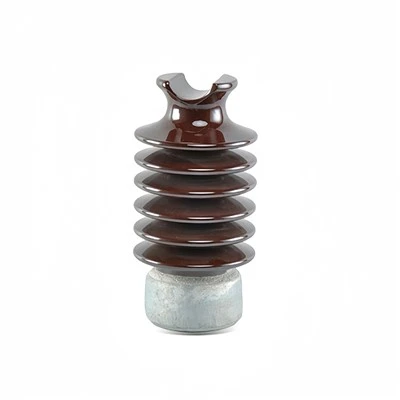
As a supplier of Composite Line Post Insulators, I've seen firsthand the rapidly growing demand for these insulators in offshore wind power generation systems. But let me tell you, it's not all smooth sailing. There are a bunch of challenges that come with using these insulators in such a tough environment.
Harsh Environmental Conditions
One of the biggest headaches for Composite Line Post Insulators in offshore wind farms is the harsh environment. Out there at sea, these insulators are constantly pummeled by strong winds, salty air, and extreme temperature variations.
The salt in the air is a real killer. Salt particles can accumulate on the surface of the insulators. Over time, this forms a conductive layer. When this happens, it can cause a decrease in the insulator's performance. The electrical resistance drops, and there's an increased risk of flashovers. Flashovers are those sudden and unwanted electrical discharges that can really mess up the power system. It's like a short - circuit in the worst - case scenario.
Then there are the strong winds. Offshore winds can be incredibly powerful. They apply a lot of mechanical stress on the insulators. The insulators need to be strong enough to withstand these forces without breaking or getting damaged. If they can't handle the stress, they might crack or even snap. And once that happens, it's a big problem for the whole power generation system.


Temperature variations are also a major issue. The temperature can change quite a bit between day and night, and also with the changing seasons. Composite materials expand and contract with temperature changes. If the insulator isn't designed to handle these thermal expansions and contractions properly, it can lead to internal stresses. These stresses can cause cracks in the insulator, which again, compromise its performance.
Electrical Performance Requirements
Offshore wind power generation systems have some pretty high - end electrical performance requirements. The voltages involved are often quite high, and the insulators need to be able to handle them without any issues.
Composite Line Post Insulators need to have excellent dielectric properties. The dielectric constant needs to be stable over a wide range of frequencies and temperatures. If the dielectric properties aren't up to par, it can lead to electrical losses. These losses can reduce the efficiency of the power transmission system.
Another critical aspect is the withstand voltage. The insulators must be able to withstand the transient over - voltages that occur during lightning strikes or switching operations. Lightning is a common occurrence at sea, and a single strike can generate extremely high voltages. If the insulator can't handle these over - voltages, it can break down, causing a power outage.
Partial discharge is also a concern. Even small partial discharges can gradually damage the composite material over time. These discharges can erode the insulator's surface, weaken its structure, and eventually lead to complete failure. So, the insulators need to have a high resistance to partial discharges.
Installation and Maintenance
Installation of Composite Line Post Insulators in offshore wind farms is no walk in the park. First of all, access to these farms can be quite difficult. You need specialized vessels and equipment to transport and install the insulators. The weather conditions at sea can also be unpredictable. High waves, storms, and strong winds can delay the installation process and make it extremely dangerous for the workers.
Once the insulators are installed, maintenance becomes another challenge. Regular inspections are necessary to ensure that the insulators are in good condition. But getting to the offshore wind turbines for inspection is not easy. It requires careful planning and coordination. The inspection process itself can be time - consuming and expensive.
If a problem is detected during the inspection, repairs can be even more complicated. Replacing a damaged insulator means taking the turbine offline for some time, which results in lost power generation. And finding the right replacement parts quickly can be a struggle, especially if the insulators are custom - made for a particular wind farm.
Compatibility with Other Components
In an offshore wind power generation system, Composite Line Post Insulators need to work in harmony with other components. For example, they need to be compatible with the conductors they are supporting. The connection between the insulator and the conductor must be secure and reliable. If the connection isn't good, it can lead to overheating, which can damage both the insulator and the conductor.
They also need to be compatible with the tower structure. The insulators are usually mounted on the towers, and the mounting system needs to be designed to transfer the mechanical loads properly. If there's a mismatch between the insulator and the tower structure, it can cause excessive stress on the insulator, leading to premature failure.
Competition from Other Insulator Types
Composite Line Post Insulators aren't the only game in town. There are other types of insulators out there, like Corner Post Insulators, Line Post Type Insulator, Metal Post Insulators, and Glass Line Post Insulator. Each of these insulator types has its own advantages and disadvantages.
Glass insulators, for example, are known for their high mechanical strength and good electrical performance. They are also relatively easy to manufacture and recycle. Metal insulators can offer high thermal conductivity, which can be useful in some applications. These competing insulator types can sometimes be more cost - effective or better - suited for certain aspects of offshore wind power systems. This makes it a tough battle for Composite Line Post Insulators to gain a larger market share.
Conclusion
Despite all these challenges, Composite Line Post Insulators still have a lot going for them. Their light weight makes them easier to handle during installation compared to some of the other insulator types. They also have good resistance to vandalism and can be designed to have a long service life.
As a supplier, I'm always working on finding solutions to these challenges. We're constantly researching and developing new materials and designs to improve the performance of our insulators. We're looking into better ways to protect against salt contamination, enhance mechanical strength, and improve electrical performance.
If you're in the market for Composite Line Post Insulators for your offshore wind power project, I'd love to have a chat with you. We can discuss your specific requirements and how our insulators can meet those needs. Contact us to start the conversation and let's find the best insulator solutions for your project.
References
- Johnson, A. (2020). "Challenges in Offshore Wind Power Insulation". Journal of Renewable Energy.
- Smith, B. (2021). "Composite Materials for Electrical Insulation in Harsh Environments". Materials Science Review.
- Brown, C. (2019). "Insulator Compatibility in Power Generation Systems". Energy Engineering Journal.