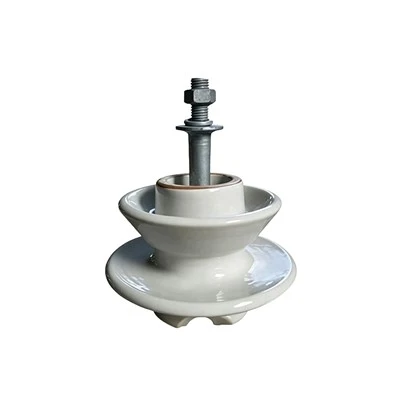
What are the Capacitive Properties of Pin Insulators?
As a leading supplier of pin insulators, I've had the privilege of delving deep into the technical nuances of these essential electrical components. Pin insulators are widely used in overhead power lines to support and insulate conductors, ensuring the safe and efficient transmission of electricity. One of the key aspects that significantly impacts their performance is their capacitive properties. In this blog, we'll explore what these capacitive properties are, why they matter, and how they influence the overall functionality of pin insulators.
Understanding Capacitance in Pin Insulators
Capacitance is a fundamental electrical property that describes the ability of a system to store electrical energy in an electric field. In the context of pin insulators, capacitance arises due to the presence of two conductive elements (the conductor and the supporting structure) separated by an insulating material (the pin insulator itself). This configuration forms a capacitor, where the insulating material acts as the dielectric.
The capacitance of a pin insulator is determined by several factors, including the geometry of the insulator, the permittivity of the insulating material, and the spacing between the conductor and the supporting structure. The permittivity, often denoted as ε, is a measure of how easily an electric field can penetrate a material. Different materials used in pin insulators, such as ceramic, polymer, or glass, have different permittivities, which directly affect the capacitance.
For example, ceramic materials typically have a relatively high permittivity, which means they can store more electrical energy per unit volume compared to materials with lower permittivity. This property makes ceramic pin insulators Ceramic Pin Insulator suitable for applications where higher capacitance is required.
Importance of Capacitive Properties
The capacitive properties of pin insulators play a crucial role in several aspects of power system operation. One of the primary functions is voltage distribution. In an overhead power line, the voltage across the insulators is not uniformly distributed. The capacitance of the insulators helps to balance the voltage distribution along the line, reducing the risk of excessive voltage stress on individual insulators.
When the capacitance is properly balanced, the voltage across each insulator is more evenly distributed, which helps to prevent premature aging and failure of the insulators. This is particularly important in high-voltage transmission lines, where the voltage gradients can be significant.
Another important aspect is the performance of the insulators under transient conditions, such as lightning strikes or switching operations. The capacitance of the insulators can influence the response of the system to these transient events. For example, during a lightning strike, the capacitance can help to absorb and dissipate the energy of the lightning surge, protecting the power system from damage.
Factors Affecting Capacitive Properties
Several factors can affect the capacitive properties of pin insulators. One of the most significant factors is the design and geometry of the insulator. The shape, size, and number of insulator discs or sheds can all influence the capacitance. For example, insulators with a larger surface area or more complex geometries may have higher capacitance due to the increased amount of electric field storage.
The material used in the insulator also plays a crucial role. As mentioned earlier, different materials have different permittivities, which directly affect the capacitance. In addition, the quality and purity of the material can also impact the capacitive properties. For example, impurities or defects in the material can alter the electric field distribution and reduce the overall capacitance.
Environmental conditions can also have an impact on the capacitive properties of pin insulators. Moisture, pollution, and temperature variations can all affect the performance of the insulator material and its dielectric properties. For example, moisture can increase the conductivity of the insulator surface, leading to a change in the capacitance. Similarly, pollution can accumulate on the insulator surface, forming a conductive layer that can also affect the capacitive performance.
Capacitive Properties of Different Types of Pin Insulators
There are several types of pin insulators available on the market, each with its own unique capacitive properties. Let's take a closer look at some of the most common types:
- Ceramic Pin Insulators: As mentioned earlier, ceramic materials have relatively high permittivity, which results in higher capacitance. Ceramic pin insulators Ceramic Pin Insulator are known for their excellent mechanical strength and thermal stability, making them suitable for a wide range of applications. They are often used in high-voltage transmission lines and substations.
- Overhead Line Pin Insulators: These insulators are specifically designed for use in overhead power lines. They are typically made of ceramic or polymer materials and are available in various shapes and sizes to meet the specific requirements of different line configurations. Overhead line pin insulators Overhead Line Pin Insulator are designed to provide reliable insulation and support for the conductors, while also ensuring proper voltage distribution.
- Lightning Protection Pin Insulators: These insulators are designed to provide additional protection against lightning strikes. They are typically equipped with lightning protection devices, such as surge arresters or lightning rods, which help to divert the lightning current safely to the ground. Lightning protection pin insulators Lightning Protection Pin Insulator have specific capacitive properties that are optimized for lightning protection applications.
- Polymer Pin Type Insulators: Polymer materials have lower permittivity compared to ceramic materials, which results in lower capacitance. However, polymer pin type insulators Polymer Pin Type Insulators offer several advantages, such as lighter weight, better pollution performance, and ease of installation. They are often used in distribution networks and applications where weight and environmental factors are important considerations.
- Anti-Pollution Pin Insulators: These insulators are designed to resist the effects of pollution and contaminants. They are typically made of materials with hydrophobic properties, which prevent the accumulation of moisture and pollutants on the insulator surface. Anti-pollution pin insulators Anti-Pollution Pin Insulator have specific capacitive properties that are optimized for operation in polluted environments.
Measuring Capacitive Properties
Accurately measuring the capacitive properties of pin insulators is essential for ensuring their proper performance. There are several methods available for measuring capacitance, including the use of capacitance meters, bridge circuits, and impedance analyzers.


Capacitance meters are the simplest and most common method for measuring capacitance. They work by applying a known voltage to the insulator and measuring the resulting current. The capacitance can then be calculated using the formula C = Q/V, where C is the capacitance, Q is the charge stored on the capacitor, and V is the applied voltage.
Bridge circuits, such as the Schering bridge or the Wien bridge, are more accurate and precise methods for measuring capacitance. They work by comparing the unknown capacitance with a known capacitance using a balancing network. The bridge is balanced when the impedance of the unknown capacitor is equal to the impedance of the known capacitor.
Impedance analyzers are the most advanced and accurate method for measuring capacitance. They work by applying a wide range of frequencies to the insulator and measuring the resulting impedance. The capacitance can then be calculated from the impedance data using complex mathematical algorithms.
Conclusion
The capacitive properties of pin insulators are a critical factor in their performance and reliability. Understanding these properties and how they are affected by various factors is essential for designing, selecting, and operating power systems. As a pin insulator supplier, we are committed to providing high-quality products with optimized capacitive properties to meet the specific requirements of our customers.
If you are in the market for pin insulators or have any questions about their capacitive properties, please do not hesitate to contact us. Our team of experts is available to discuss your needs and provide you with the best solutions for your power system.
References
- Electrical Insulation Handbook, McGraw-Hill Education.
- Power System Analysis and Design, Cengage Learning.
- Insulator Technology, IEEE Press.